
Among the main tests we can perform in our laboratories to evaluate and validate new processes and technologies, there are:
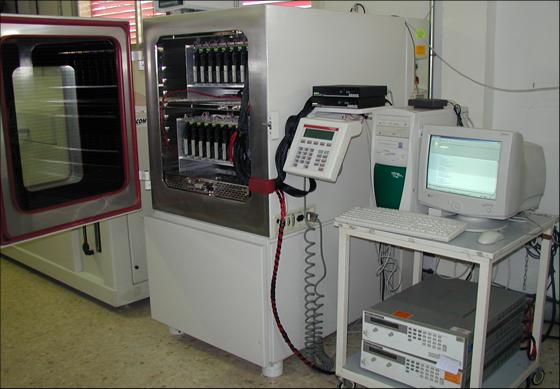

The aim of this type of aging test is to qualitatively characterize intermetallic growth. It is a long-duration, high-temperature test — 1000 hours at 125°C. Technical standards: IEC60068 (Environmental Testing Procedures)
This test method is used to quantify the harmful effects of manufacturing, process or handling residues on Surface Insulation Resistance (SIR) in the presence of humidity. The electrodes (electrically biased during conditioning to facilitate electrochemical reactions) lie along parallel traces on a standard printed board or assembled board; the samples are then conditioned and measurements are taken at a high humidity level. Test Method: IPC TM-650 2.6.3.7 (Surface Insulation Resistance)
Test Method: IPC TM-650 2.6.3.7 (Surface Insulation Resistance)
The aim of this test is to evaluate the stress on solder joints as a function of temperature variation. ATC consists of a slow temperature variation, no more than 20°C per minute. Thermal cycling induces different thermal expansion/contraction depending on material composition, generating mechanical stresses that create plastic deformation in the material. This accelerates the material’s life cycle. For example, thermal cycling can cause micro-cracks inside solder joints and, after a certain number of cycles, lead to complete failure. Technical standards: IEC60068 (Environmental Testing Procedures)
The aim of this test is to evaluate the impact of chemical substances on the PCBA (e.g. flux residues). The test is performed in line with the JEDEC JESD22-100C standard, with the following test parameters: duration of 240 hours, temperature of 85°C and relative humidity of 85%. The functional test result is considered positive if no dendritic growth is found. Technical standards: IEC60068 (Environmental Testing Procedures)
Thermal shocks differ from thermal cycles in the rapid temperature variation; for this reason, they also induce different failure mechanisms. During thermal shocks, materials undergo deformation phenomena; on PCBAs they cause deformation of the PCB or of the assembled components, generating deformation perpendicular to the board surface. Technical standards: IEC60068 (Environmental Testing Procedures)
Type: Double chamber
Test: Thermal Cycle Chamber, Thermal Shock Test
Quantity: 2
Features: -60°C / +200°C
Standard profiles: -55°C / +125°C
Ramp rate: Immediate transition
Usable dimensions (WxHxD): 530x450x660 mm
Type: Double chamber
Test: Thermal Cycle Chamber, Thermal Shock Test
Quantity: 1
Features: -80°C / +200°C
Standard profiles: -55°C / +125°C
Ramp rate: Immediate transition
Usable dimensions (WxHxD): 470x650x410 mm
Type: Single chamber
Test: Thermal Cycle Chamber, Temperature Cycling Test
Quantity: 1
Features: -30°C / +150°C
Standard profiles: 0°C / +100°C
Ramp rate: 10°C / min
Usable dimensions (WxHxD): 580x320x450 mm
Type: Single chamber
Test: Thermal Cycle Chamber,
Temperature Cycling Test
Quantity: 1
Features: -70°C / +180°C
Standard profiles: -40°C / +100°C | -55°C / +125°C
Ramp rate: 12°C / min
Usable dimensions (WxHxD): 800x1000x600 mm
Type: Single chamber
Test: Thermal Cycle Chamber,
Temperature Cycling Test
Quantity: 2
Features: -30°C / +200°C
Standard profiles: 0°C / +100°C. | 0°C / +125°C
Ramp rate: max 8°C / min
Usable dimensions (WxHxD): 340x340x435 mm
Type: Single chamber
Test:
Thermal Cycle Chamber,
Temperature Cycling Test
Quantity: 1
Features: -70°C / +200°C
Standard profiles:
-40°C / +65°C
-10°C / +150°C
Ramp rate: 10°C / min
Usable dimensions (WxHxD):
340x340x435 mm
Type: Single chamber
Test:
Thermal Cycle Chamber,
Temperature Cycling Test
Quantity: 1
Features: -70°C / +180°C
Standard profiles:
-40°C / +100°C
-55°C / +125°C
Ramp rate: 7°C / min
Usable dimensions (WxHxD):
700x1000x700 mm
Type: Climatic Chamber
Test:
Temperature,
Humidity,
Bias SOAK
Quantity: 3
Features:
-40°C / +150°C
10/98% RH
Standard profiles:
+85°C / 85% RH,
+30°C / 60% RH
Necessary sizes (LXHXP):
575x645x550 mm
Type: Climatic Chamber
Test:
Temperature,
Humidity,
Bias SOAK
Quantity: 1
Features:
-75°C / +180°C,
10/98% RH
Standard profiles:
+85°C / 85% RH,
+30°C / 60% RH
Usable dimensions (WxHxD):
580x750x450 mm
Type: Climatic Chamber
Test:
Temperature,
Humidity,
Bias SOAK
Quantity: 2
Features:
-40°C / +180°C,
10/98% RH
Standard profiles:
+85°C / 85% RH,
+30°C / 60% RH
Usable dimensions (WxHxD):
820x700x700 mm
Type: Single chamber
Test:
Thermal Cycle Chamber,
Temperature Cycling Test
Quantity: 2
Features: -55°C / +180°C
Standard profiles:
-40°C / +100°C
-55°C / +125°C
Ramp rate: 3°C / min
Usable dimensions (WxHxD):
520x700x520 mm
Type: Thermal Oven
Test:
Cure & Bake
Quantity: 1
Features: +150°C
Standard profiles: +40°C / +250°C
Usable dimensions (WxHxD):
430x430x480 mm
Type: Thermal Oven
Test: Cure & Bake
Quantity: 1
Features: +125°C
Standard profiles: +40°C / +200°C
Necessary sizes (LXHXP):
430x450x460 mm
Technological reliability is the ability of a product or material to meet operating or usage expectations over time.
Validation plans are a structured set of tests and laboratory analyses that verify and certify a product’s capability.
Our labs are the perfect partner for developing you researches.
Contact our experts to request a consultation.
